
The Paper Trail · The Mediation
Mediation: the ‘uncommon’ offer that followed the lawsuit
On September 22, the Master Association and the commercial owners suing it sit down with a mediator. The Club told owners that offering to mediate was a courtesy. The lawsuit came six weeks before the offer, and a pending motion argues Florida law puts mediation first.
What does the Club want? The demands are written in two documents: the lawsuit it filed, and the draft it sent to owners.
Filed lawsuit · May 15, 202611 pages · two counts · both about the roads
- Count IDeclare the road rights. A ruling on “what rights Plaintiffs have concerning access to the roads within the Resort,” including the right “to provide transportation to guests.”
- Count IIAn injunction barring the association from interfering with that transportation, sought on an emergency basis for the May 16 wedding.
Unfiled draft amendment · sent to owners June 26245 pages · nine counts · would grow the same case · in plain terms it asks a court to:
- Counts I–IIRestore the commercial board seats. Declare the 2023 amendments that removed commercial owners from the TMA board invalid, bar the association from enforcing them, and award damages for breaching the 1999 Settlement Agreement.
- Count IIIStrike the 2024 amendments “in whole or in part,” the changes that include the beach-access restrictions.
- Count IVEnd the registration fee, and take back the money. Declare the 2021 fee amendment invalid, stop collection, and order “disgorgement of Defendant’s wrongfully obtained funds.” The money would go back to the Club, not to owners and not to the guests who paid it: see Part IV: The Fee.
- Count VMoney for business harm. Damages for “lost profits and lost business opportunities,” damage to “business reputation and goodwill,” and lost business relationships, in amounts to be set at trial.
- Counts VI–VIIRights to the irrigation well and pump on the commercial office property: a ruling that the association’s control of the pump facilities is not exclusive, plus damages.
- Count VIIIRemove the association’s fence from the commercial office property, with a writ of possession and damages for “wrongful possession.”
- Count IXThe roads, and the tram. Declare the Club’s right to run guest transportation on the resort’s roads and permanently bar interference: the same fight the filed case already raises.
Nearly every count also asks for attorneys’ fees and costs. Wording in quotes is verbatim from the draft’s demand clauses.
On September 11, the Master Association’s community manager emailed every owner a one-page message from the TMA board. It confirmed a date owners had heard only secondhand: mediation on September 22, 2026, “concerning the ongoing disputes involving commercial owners and the Master Association of TOPS’L.” The message promised the board would approach the table “with the interests of the entire TOPS’L community in mind.”
How September 22 came to exist depends on who is telling it. In the commercial owners’ June 26 newsletter to every owner, mediation was a gift: “Though uncommon, in the interest of transparency,” they wrote, they would give the Master Association “a 90-day opportunity to work toward a resolution and participate in mediation” before filing an expanded lawsuit. The court file tells the story in a different order. The commercial owners had already sued the association six weeks earlier, on May 15. And five days after the newsletter, on July 1, the association asked a judge to throw that case out on a single ground: § 720.311 of the Florida Statutes, its motion argues, required mediation before the suit was ever filed, and no mediation demand was ever served.
Three dates, in the order they happened: the lawsuit, May 15. The “uncommon” offer to mediate, June 26. The motion calling mediation a skipped legal requirement, July 1. Mediation is confidential, and whatever happens in the room will not be announced from it. The paperwork that put the room on the calendar is public, and it follows.
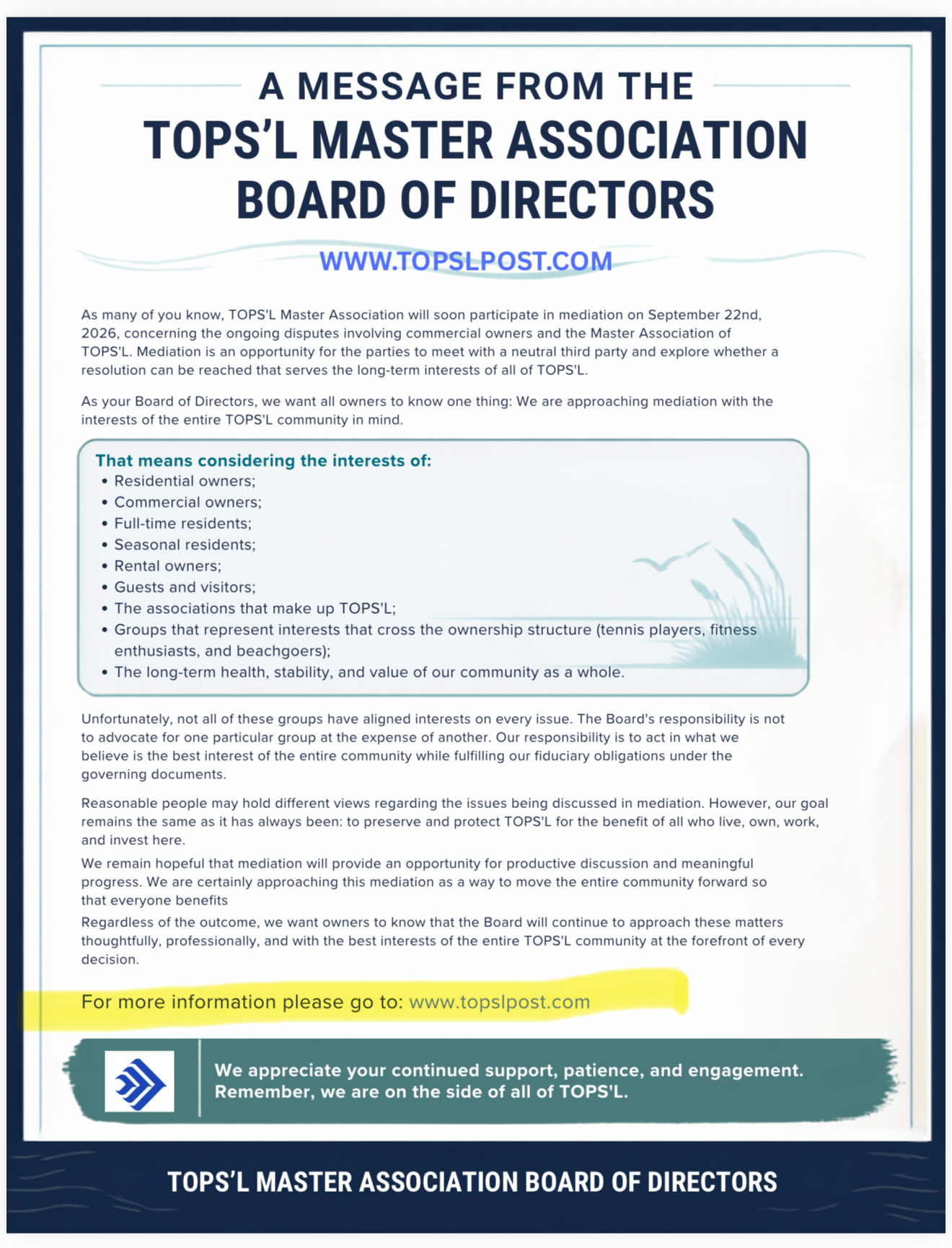
A deadline, delivered to every inbox
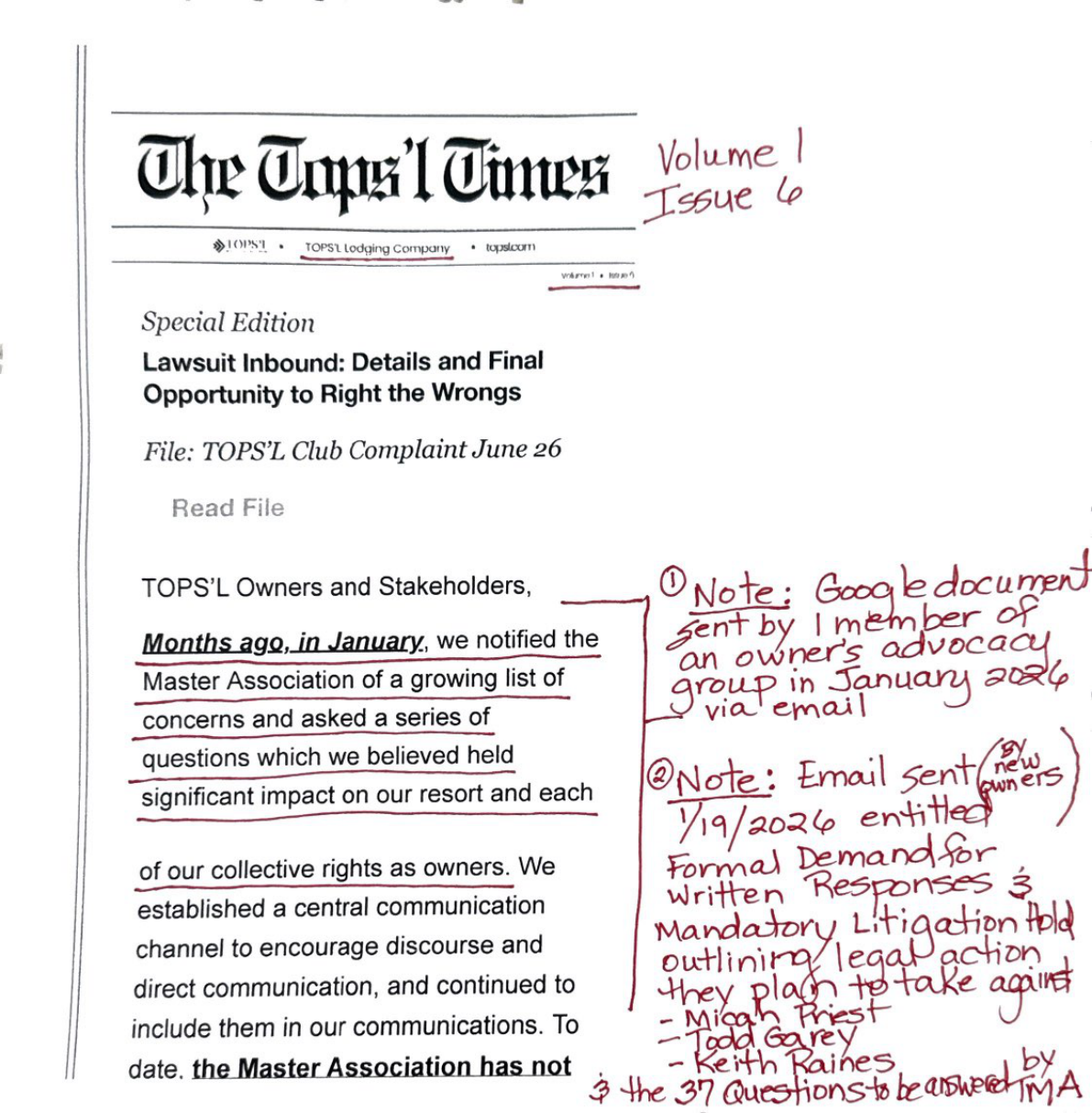
The date traces back to a newsletter. In late June, the resort’s commercial owners, writing as Tops’l Club of NW Florida under the masthead of The Tops’l Times, sent owners a “Special Edition” titled “Lawsuit Inbound: Details and Final Opportunity to Right the Wrongs.”
Two sentences in it set the date in motion. The first announced the money: “Due to the severity of the issues unearthed, our real estate team, including its ownership, are now involved and have committed to funding the steps required to right the wrongs, including initiating legal action against the Master Association and seeing it through to the end, if necessary.” The second set the clock: “Before we file the lawsuit, however, we are providing the Master Association a 90-day opportunity to work toward a resolution and participate in mediation.”
The newsletter attached the lawsuit it had in mind. “Though uncommon, in the interest of transparency, we are even attaching the draft complaint,” it said. The attachment, dated June 26, runs 245 pages with exhibits and is captioned as a First Amended Complaint: not a new case, but an expansion of the one already sitting in the Walton County courthouse, which concerns only the tram. It has not been filed, and that is the point. The draft is what the small case becomes if mediation fails, published in advance for the association, and for every owner, to read. The newsletter stated its terms: if the Master Association “is willing to unwind prior unlawful actions and restore illegally taken-away property rights,” the Club would work toward a resolution. “If they are not, we are prepared to proceed accordingly.”
Count the days. Ninety days from June 26 is September 24. The mediation is September 22, two days inside the window the newsletter drew. What sits on the mediation table, in other words, is the difference between an 11-page lawsuit and a 245-page one.
The newsletter and the draft it attached2 documents
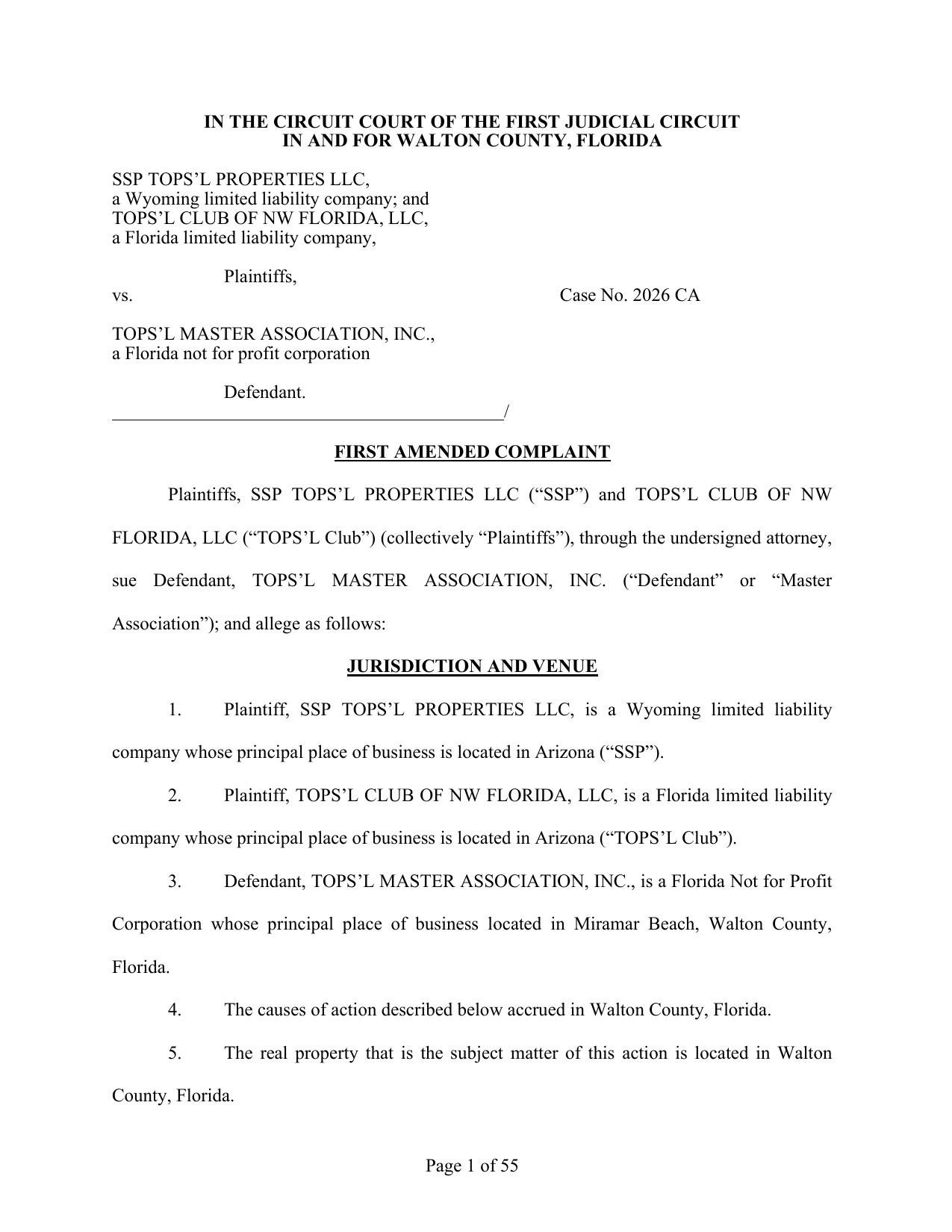
The case already in the courthouse
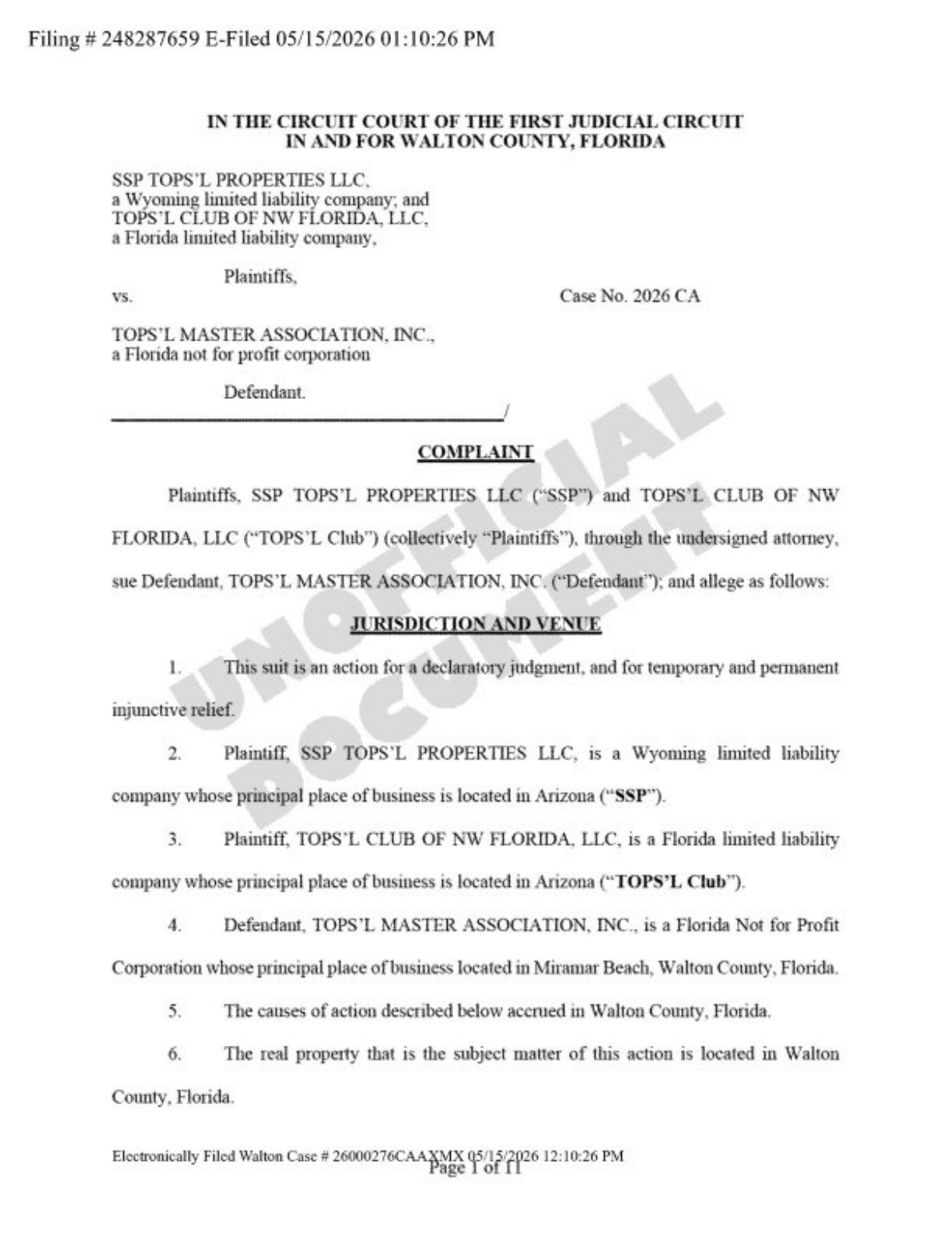
The existing lawsuit is smaller than the newsletter’s draft, and older. On May 15, 2026, SSP Tops’l Properties LLC and Tops’l Club of NW Florida LLC (together, the Club) sued the Master Association in Walton County circuit court: case 2026-CA-000276, an 11-page complaint seeking a declaratory judgment and injunctions, filed with 78 pages of exhibits. The core dispute, as both sides’ filings describe it, is whether the commercial owners may run their transportation service, the tram, on the resort’s common roadways.
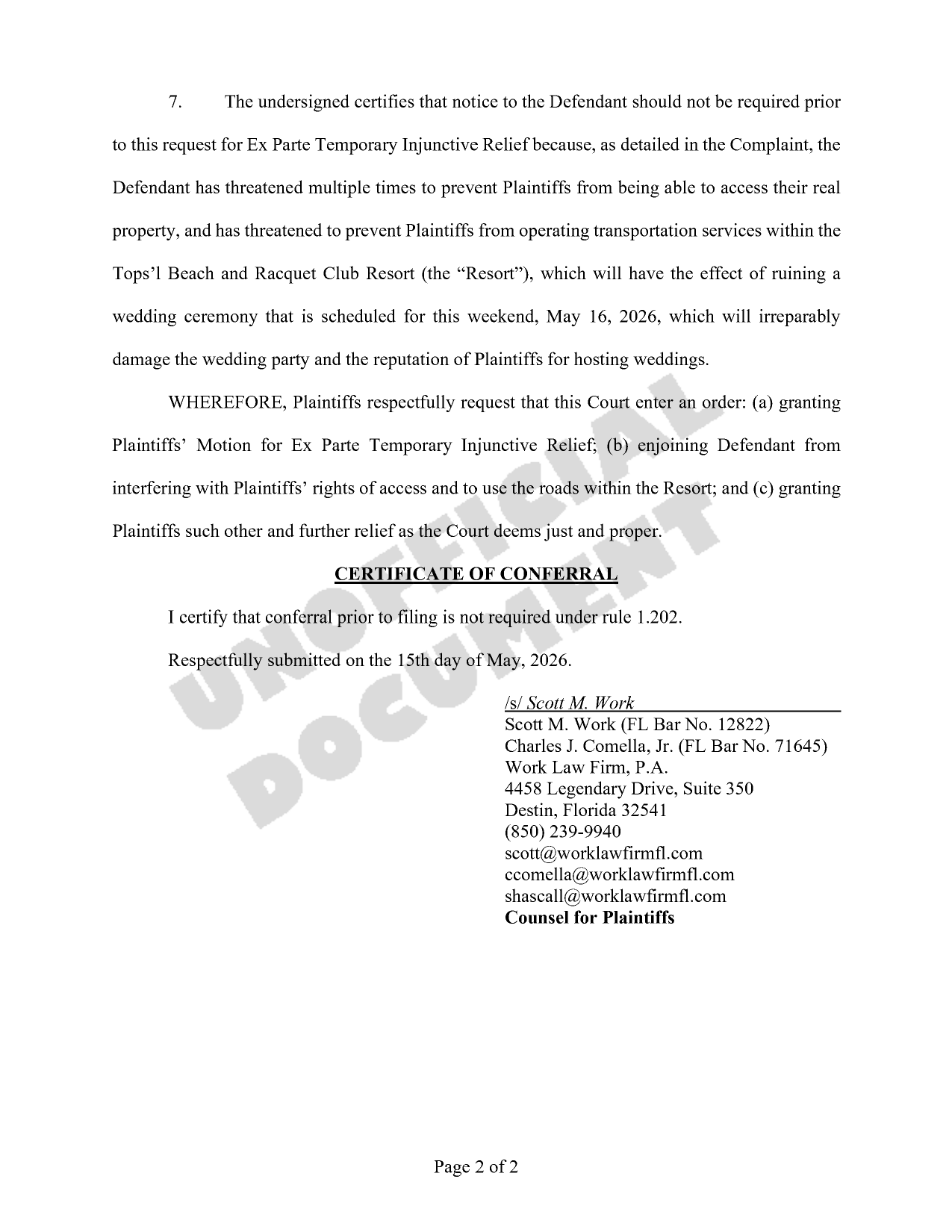
The same day, the Club asked the court for emergency relief without notifying the other side. Its sworn justification, in full:
“…the Defendant has threatened multiple times to prevent Plaintiffs from being able to access their real property, and has threatened to prevent Plaintiffs from operating transportation services within the Tops’l Beach and Racquet Club Resort (the ‘Resort’), which will have the effect of ruining a wedding ceremony that is scheduled for this weekend, May 16, 2026, which will irreparably damage the wedding party and the reputation of Plaintiffs for hosting weddings.”
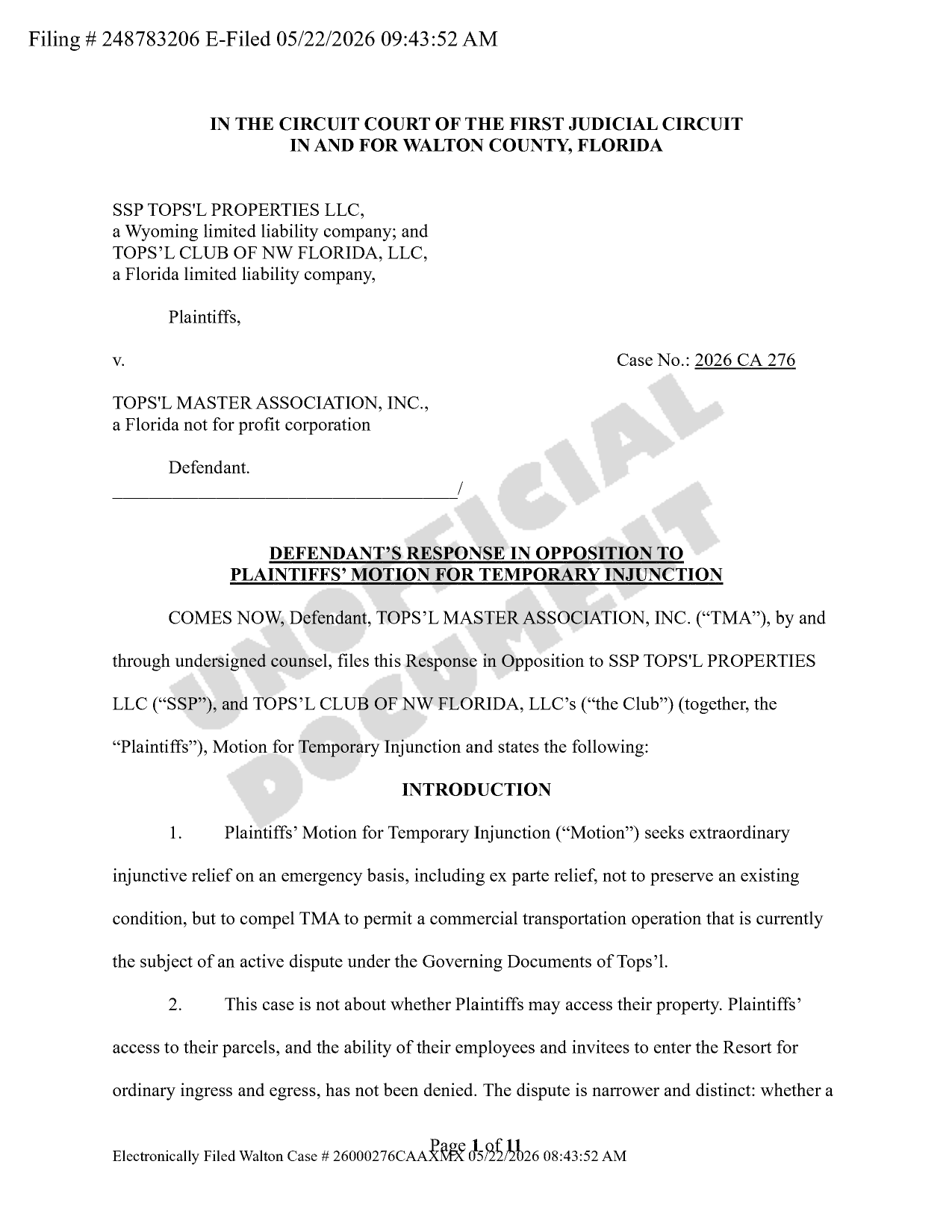
Plaintiffs’ Motion for Ex Parte Temporary Injunction, ¶7, filed May 15, 2026The association answered a week later that “Plaintiffs’ access to their parcels, and the ability of their employees and invitees to enter the Resort for ordinary ingress and egress, has not been denied,” and that the dispute was narrower than the motion made it sound.
Then the file goes quiet. The court never ruled on the emergency motion. The wedding weekend passed sixteen weeks ago. As of September 15, the docket for the case contains eleven entries, and the last one is dated July 1.
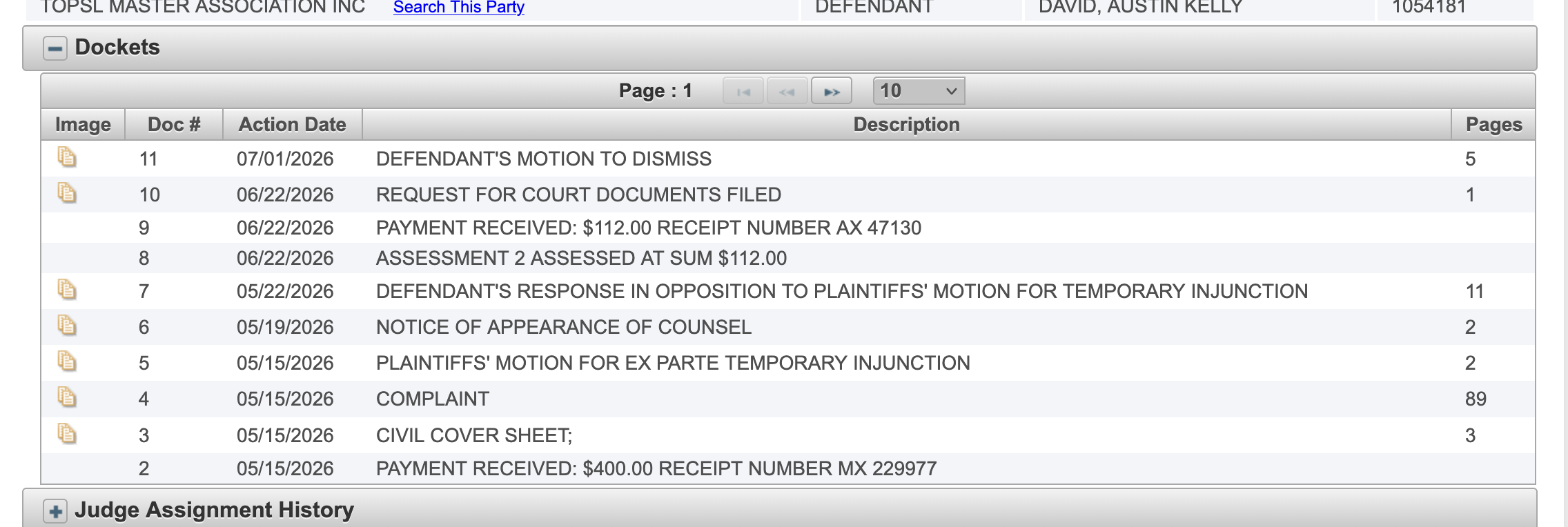
The complaint, the emergency motion and the association’s answer to it3 documents
The motion that calls mediation mandatory
That last docket entry deserves a close read, because it is about mediation.
On July 1, the association moved to dismiss the entire case. Its argument is procedural and it is blunt: “Plaintiffs filed suit without serving Defendant with a pre-suit demand for mediation, as required by § 720.311, Florida Statutes.” That statute, the motion says, “mandates pre-suit mediation for disputes between an association and a parcel owner concerning use of or changes to the parcel or the common areas,” and Florida courts “recognize dismissal of the entire action as the appropriate remedy for failure to comply.”
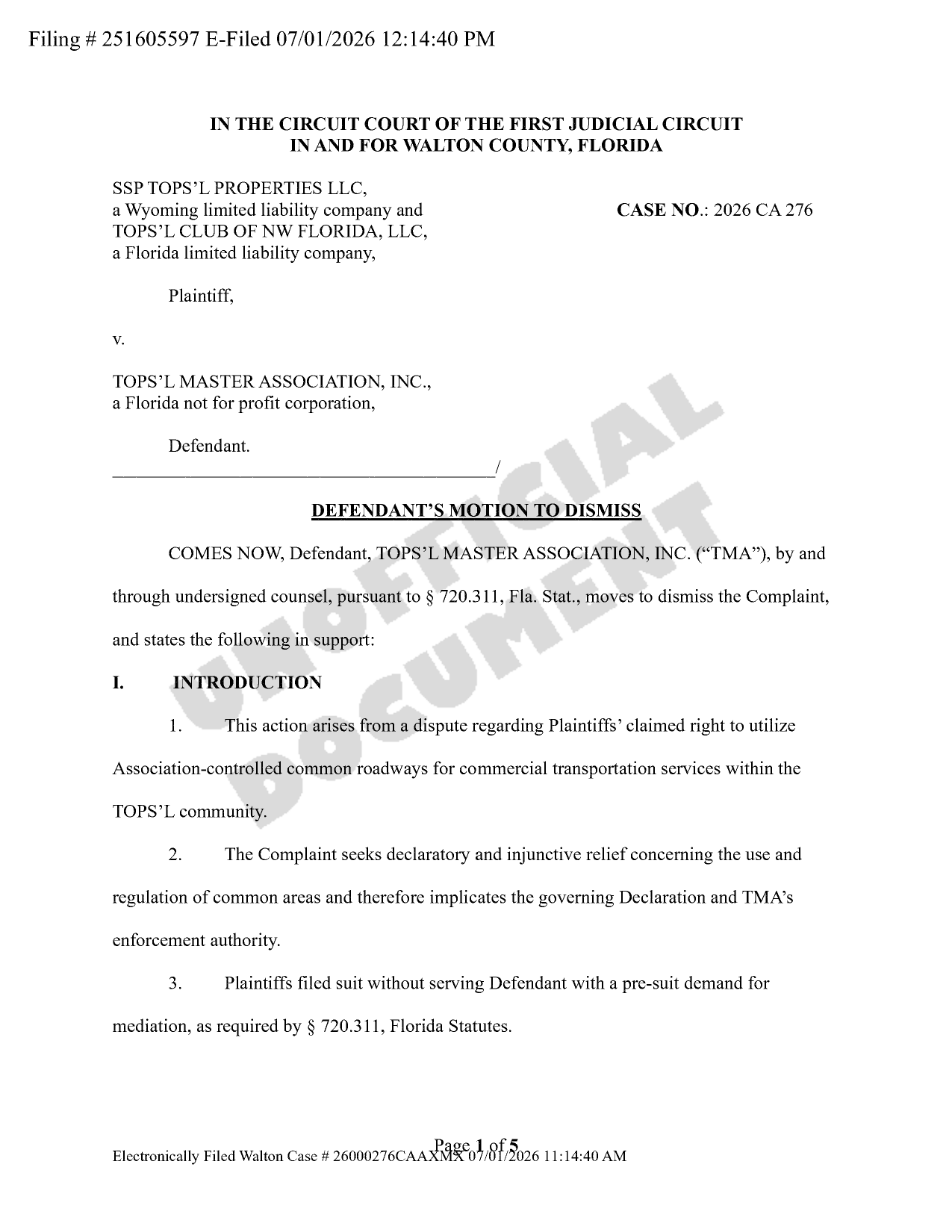
The timing gives the newsletter its second reading. The “90-day opportunity” was announced when the lawsuit it concerned was already six weeks old, and five days before the association argued in court that mediation was not a courtesy for anyone to extend but a precondition the Club had skipped. And the stakes of that argument are not small. If a judge agrees, the remedy the motion requests is not a pause while everyone talks: it is “dismissal of the entire action,” with three Florida appellate decisions cited for the point.
Both characterizations are in the record. Whether the September 22 session is the statute’s required mediation, the newsletter’s offered one, or both at once, the court file does not say. What it does say is that the Club has not answered the motion on the docket, no hearing on it appears, and the case has waited, frozen, while the mediation date approached.
Where the paper war started
The disputes going to the table are older than the lawsuit, and the January record shows the shape they had already taken.
On January 19, 2026, an email from [email protected], sent on behalf of the Club, SSP Tops’l Properties and the lodging company, delivered a “Formal Demand for Written Responses & Mandatory Litigation Hold” to three individuals: the association’s community manager and two board members. It posed 37 questions and demanded written answers within ten days. It directed two of the recipients not to enter the commercial owner’s property, citing Florida’s trespass statute. And it placed “you, Virtuous Management Group, all Tops’l HOAs, and each individual board member” on a litigation hold reaching “corporate and personal emails, texts, messaging apps, social media.”
The letter closes over a company’s name, Tops’l Club of Northwest Florida LLC. No individual signed it.
The January 19 demand, its hold, and its signature3 documents
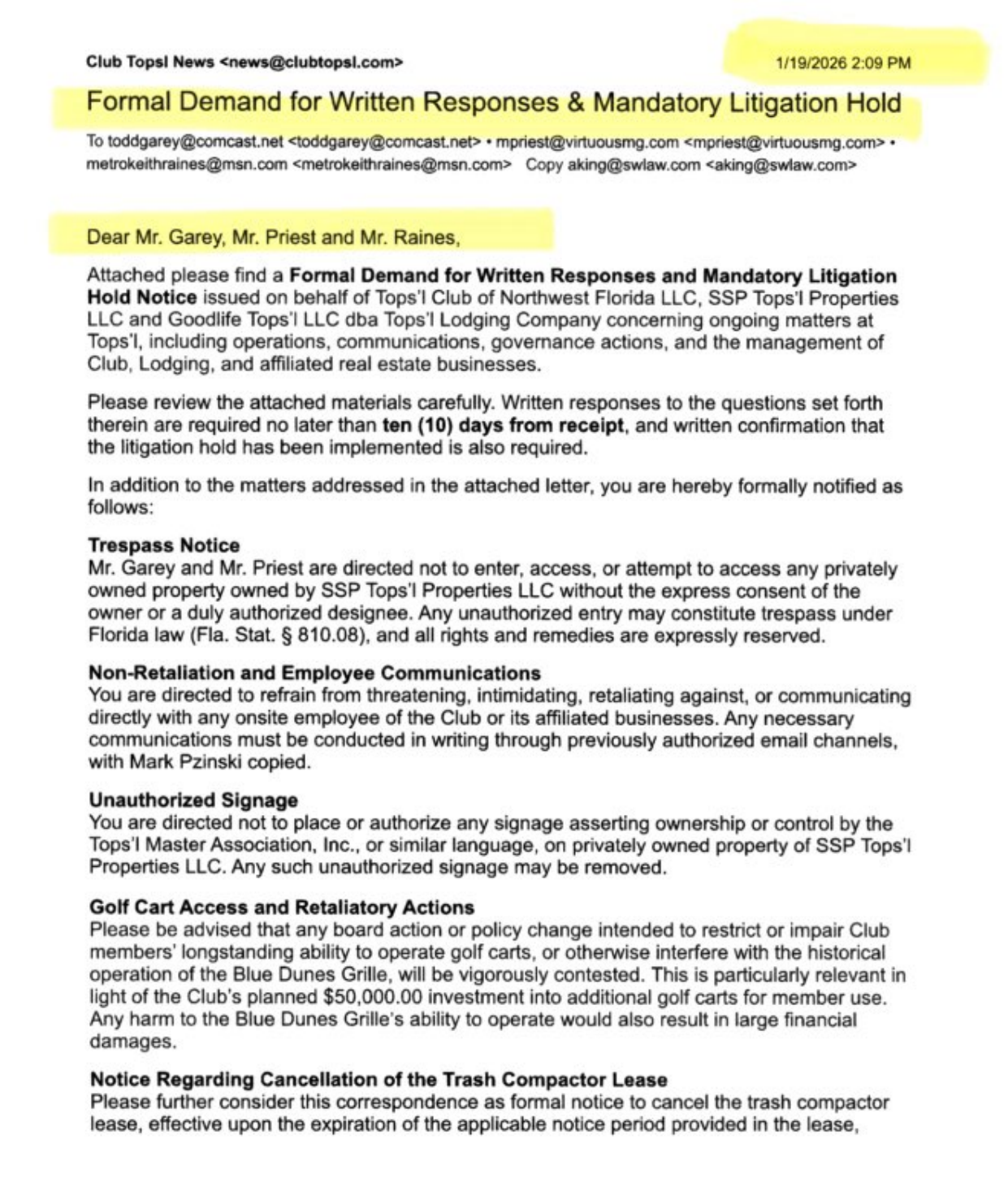
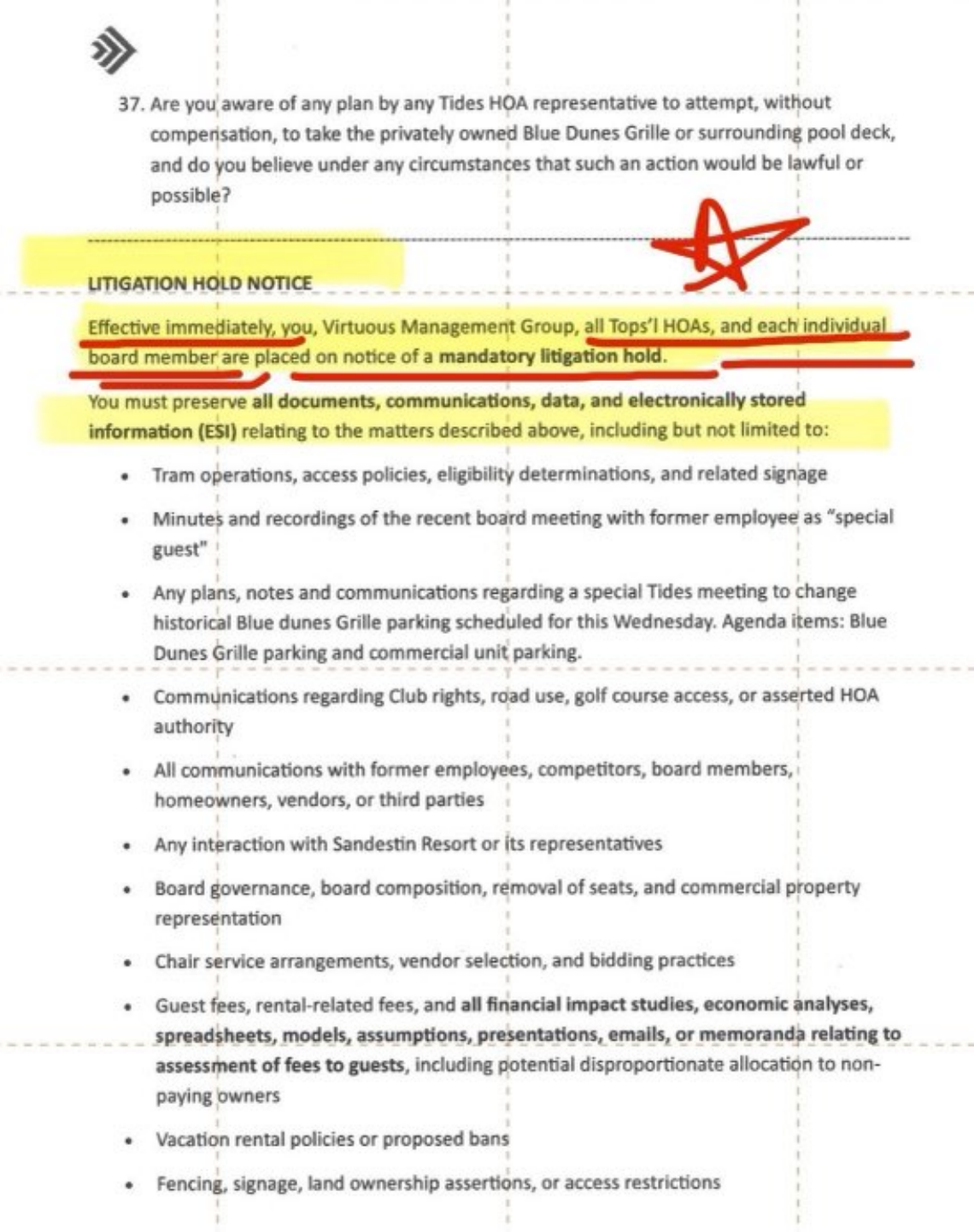
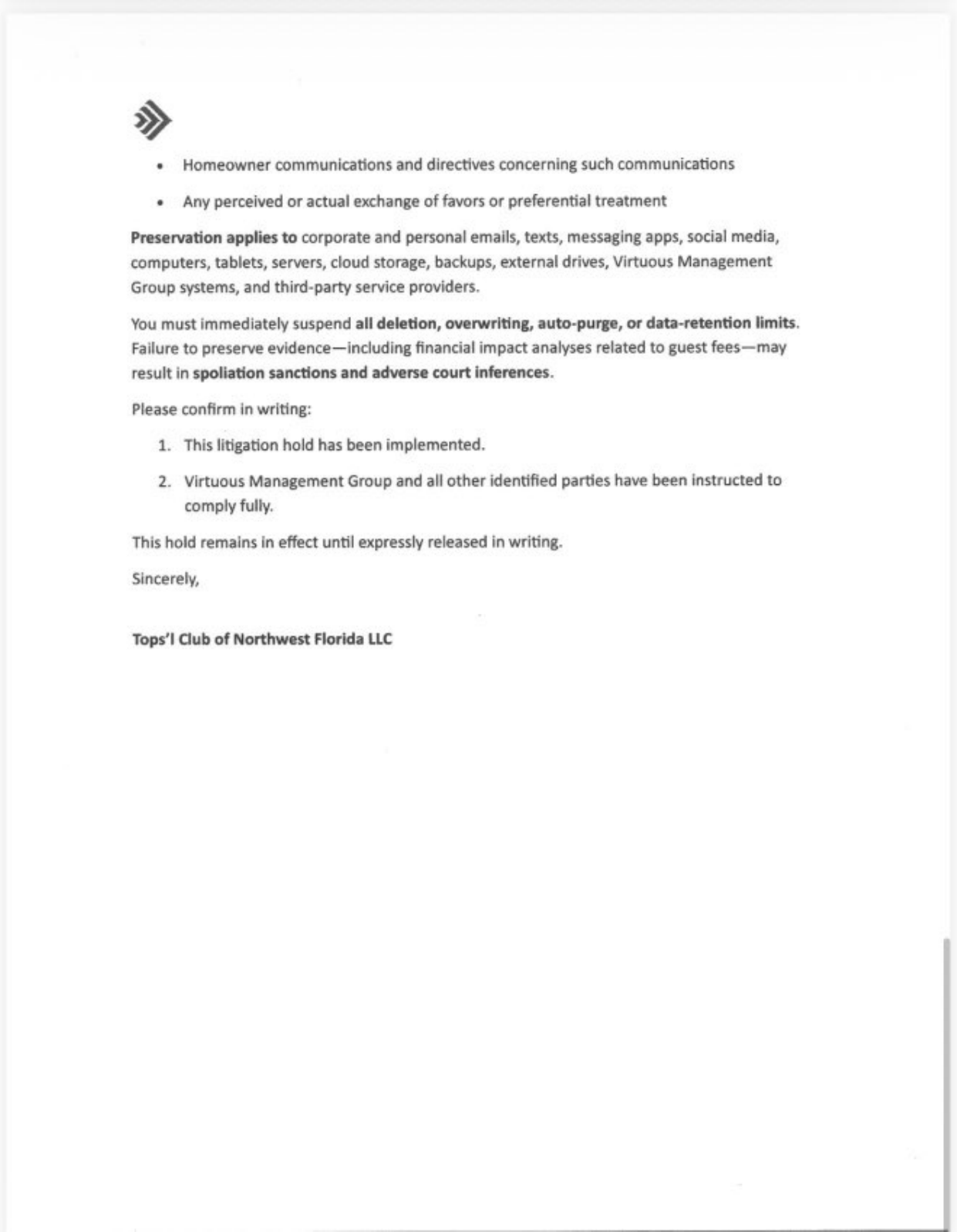
Each side’s core grievance about what followed is also on paper. The June newsletter’s complaint about the association: “the Master Association has not responded directly to a single question, nor have we received even a single attempt to engage in direct communication.” The association’s recipients, for their part, received a 37-question demand with a ten-day deadline, trespass warnings and a records hold, from a sender whose letter no person signed. Those two accounts describe the same eight months. September 22 puts their authors in the same room.
What a mediator can do, and how you’ll know
A mediator cannot impose anything on anyone. Mediation produces either a signed settlement or an impasse, and the session itself is confidential. There will be no announcement that evening, and any account of what happened in the room will be exactly that: an account.
And a settlement reaches only as far as its written terms. This dispute already contains one: the 1999 Settlement Agreement, which the Club’s draft cites as the source of the commercial board seats and accuses the association of breaching. The last settlement on this property’s record did not end the argument. Twenty-seven years later, it became Count II.
The outcome will surface in public records instead. Three places to watch:
- The docketCase 2026-CA-000276 currently ends at entry 11. A settlement tends to produce a dismissal; a failure tends to produce the next filing, possibly the 245-page amended complaint the newsletter previewed. Either way, entry 12 will say more than any Facebook post.
- The minutesAny settlement that binds the Master Association requires board action, and board action appears in minutes owners can request and read.
- The ClerkIf any agreement changes recorded rights, an instrument will be recorded in the county’s official records, searchable by either party’s name.
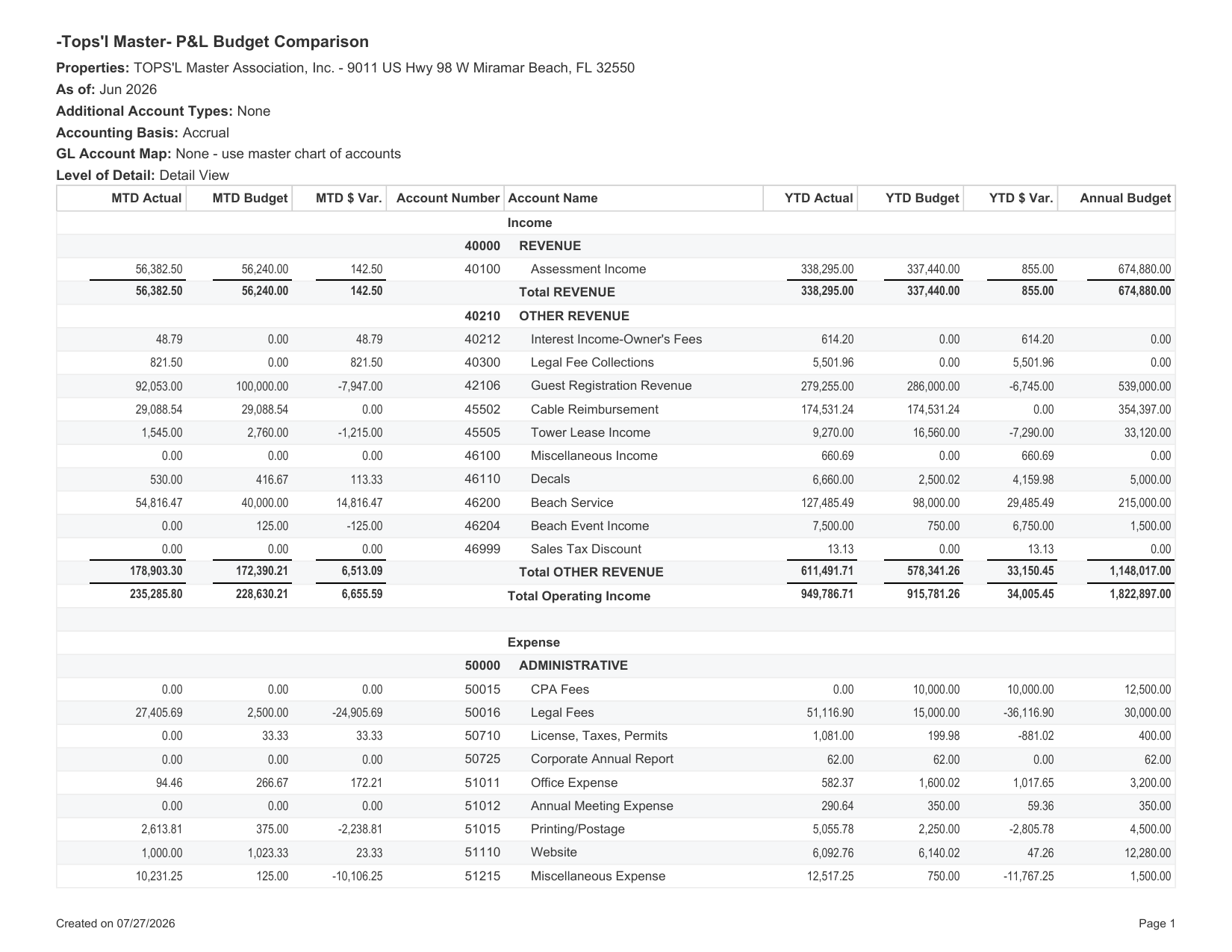
And the waiting has a price attached. The association’s June financial statement, the most recent available, shows $51,116.90 in legal fees through mid-year, against a $30,000 budget for the entire year: the annual legal budget exceeded by 70 percent with six months still to go. June alone cost $27,405.69 against a $2,500 monthly plan. The note beside the variance reads, simply, “Legal Fees – Retainer fee and general counsel.”
The case has been waiting since July 1 for somebody’s next move. After September 22, one is due.
The documents behind the story
Twelve exhibits. Open a document below, or expand the source panels in the article to read it in context.
- The board’s message, Sep 11, 2026
- The special edition
- The attached draft, page one
- The complaint, May 15, 2026
- The emergency, stated
- The docket, Sep 15, 2026
- The response, May 22, 2026
- The motion to dismiss, Jul 1, 2026
- The demand, Jan 19, 2026
- The hold’s reach
- The signature line
- The legal line, June 2026
Provenance. Court documents were obtained from the Walton County Clerk of Courts for case 2026-CA-000276 (filings of 5/15, 5/19, 5/22 and 7/1/2026) and are stamped “unofficial document” by the Clerk’s viewer; the docket register was captured September 15, 2026, and statements about what the file does or does not contain speak as of that date. The Tops’l Times Volume 1, Issue 6 newsletter and its attached draft First Amended Complaint are reproduced from the Club’s own distribution to owners; the draft complaint’s attachment is dated June 26, 2026. The TMA board’s mediation message is reproduced from the September 11, 2026 email sent to owners by the association’s community manager. The January 19, 2026 demand is reproduced from copies circulated by its recipients; highlighting visible on one page appears on the circulated copy. The legal-fee figures come from the Master Association’s own June 2026 profit-and-loss budget comparison, the most recent statement in hand as of publication.
What this article does not claim. It does not predict or characterize the outcome of mediation, does not assert which legal mechanism produced the September 22 session, and does not evaluate the merits of any claim or defense. Quotations are verbatim from the cited documents. § 720.311 is described as the association’s motion describes it; the Club has not responded to that motion on the docket, and this article takes no position on the statute’s application.
Editor’s notes. Sept. 15, 2026: An earlier version of this article referred to the mediation date as a Monday. September 22, 2026 falls on a Tuesday; because no source document names a day of the week, weekday references were removed rather than corrected. Same day: the summary of the Club’s demands was expanded to distinguish the two counts of the filed complaint from the nine counts of the unfiled draft, and moved to the top of the article; a line in the fee item was clarified to say disgorged fee money would go to the Club, not to owners or guests. A paragraph on the 1999 Settlement Agreement and the limits of settlements was also added after initial publication. Sept. 22, 2026: a link to the follow-up article on the outcome of mediation was added at the top. Sept. 23, 2026: this article’s statements that the court file contained no mention of the September 22 session were accurate as of the September 15 capture; four filings entered September 16–21 (a notice of hearing, two certificates of mediation authority and a notice of mediation) subsequently placed the mediation in the case file. They are reported in the follow-up.
Documents and corrections: [email protected]