
The fee.
Seventy-three dollars per reservation. Where it came from, who set it, what it was meant to pay for, and who now wants it back. Told entirely from the association's own minutes and books, so you can check every line.
Update, Sept. 26, 2026: The September 22 mediation ended without a settlement, the association’s board told owners. The 245-page draft complaint mailed to owners in June was not on the court docket at the latest check, September 23. The next court date is January 12, 2027: a hearing on the association’s motion to dismiss. The follow-up →
The idea, and the authority
Before the fee had a price, it had a purpose and a legal instrument. Both are on paper, and so are the names.
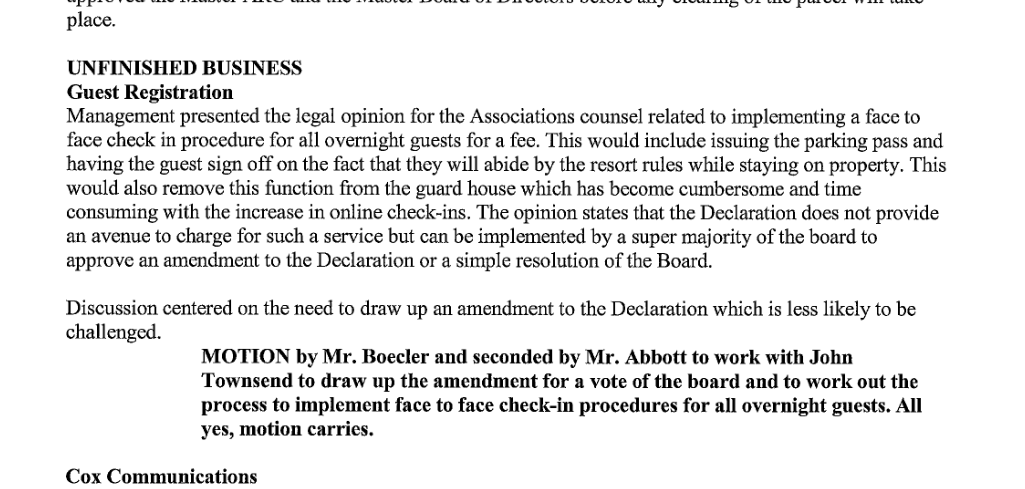
The idea came first, and its original purpose is minuted. On January 14, 2021, management presented counsel's legal opinion on "implementing a face to face check in procedure for all overnight guests for a fee." Counsel's caution is minuted too: the Declaration "does not provide an avenue to charge for such a service" without an amendment. The board voted to have the attorney draw one up.
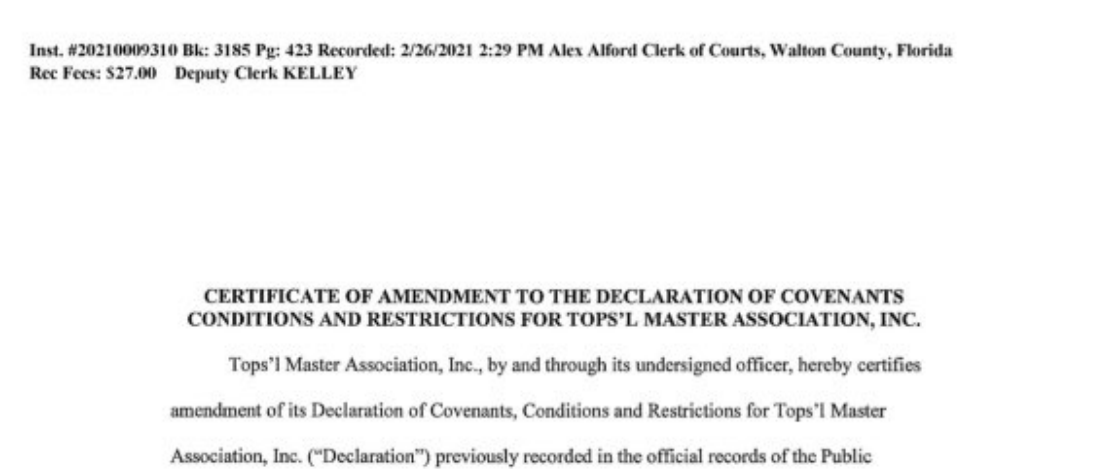
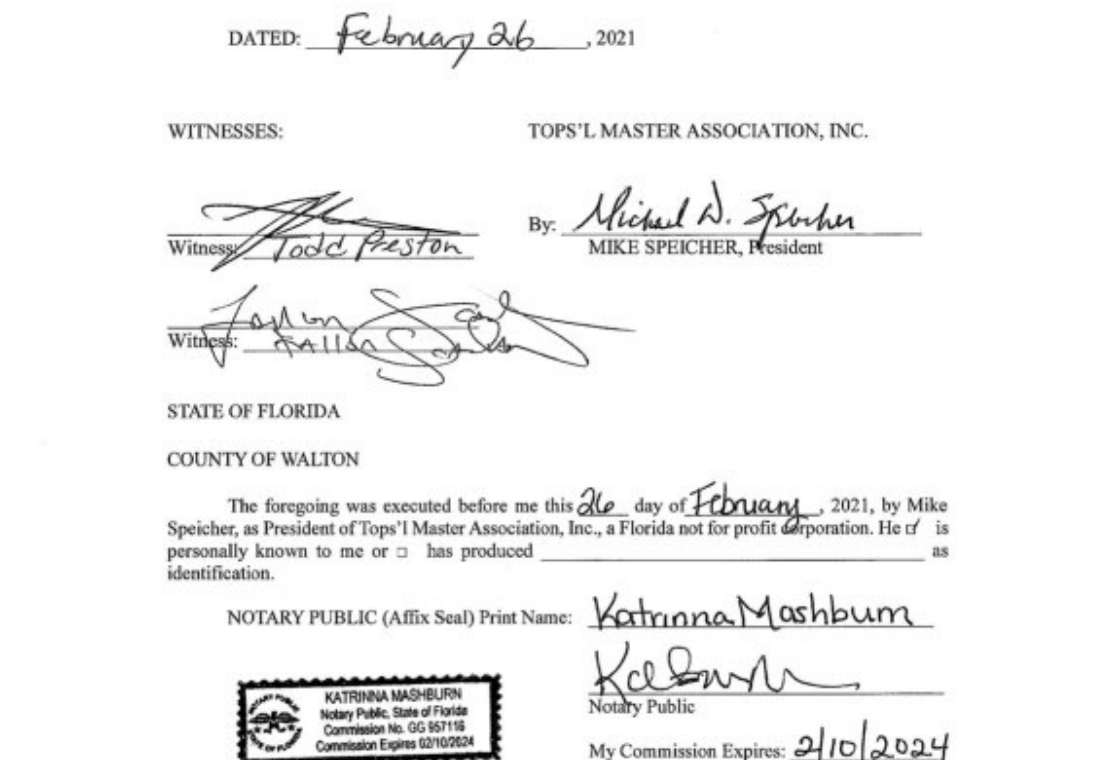
The authority came next. On February 26, 2021, an amendment to the Declaration was recorded in Walton County giving the Master Association the power to charge guest registration fees. The signature on it: Mike Speicher, President of the TOPS'L Master Association, who was at the same time the general manager of Vacasa, the resort's commercial owner. The instrument both camps now fight over was signed by a man serving both camps at once.
The price, and the first objection
One November evening in 2022 set the number, and recorded the objection the draft complaint would raise four years later.
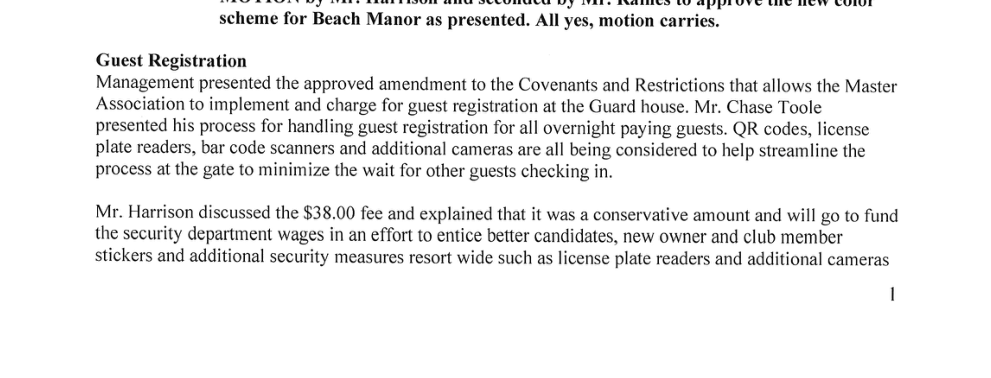
The price came that November. On November 14, 2022, the Master board set the fee at $38 per reservation, effective January 1, 2023. The motion was made by Keith Raines. It passed 6 to 1. The lone no vote came from the commercial seat: Ms. Frost of Vacasa, "dissenting due to a lack of clarity on how the revenue will be spent."
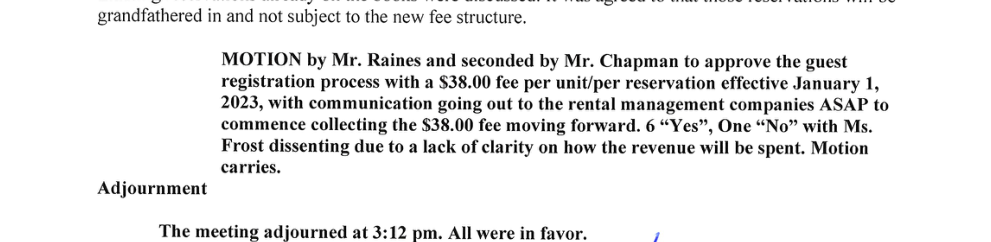
Four years later, Count IV of the draft complaint calls the fee one the association "arbitrarily sets" without connection to "any specific costs." The objection now carried by a 245-page draft complaint was first spoken inside the boardroom, by the commercial owner's seat, on the day the price was set. The minutes do not record it ever being answered.
The windfall
The fee's first year told the board everything about what it had built.
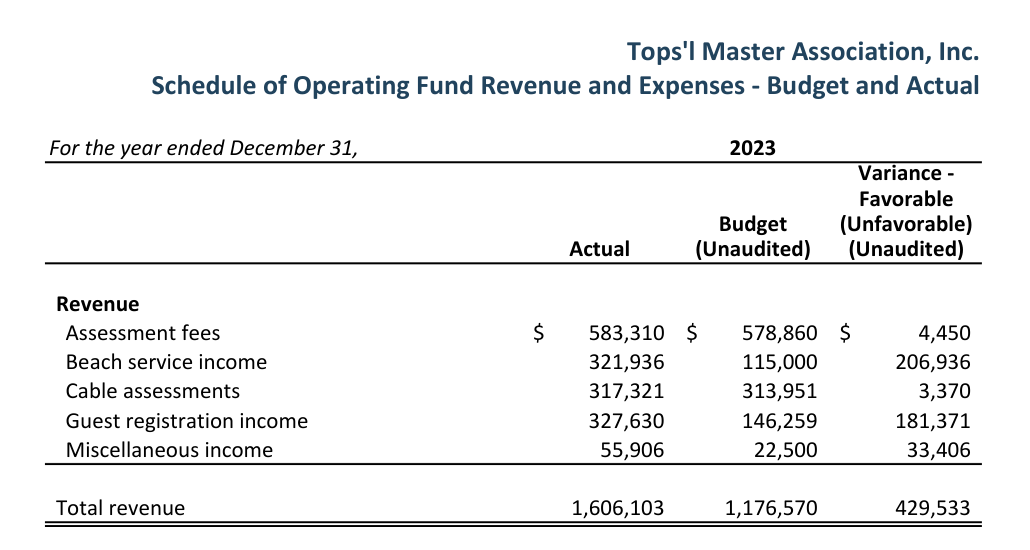
For 2023, the fee was budgeted to raise $146,259. It raised $327,630, more than double, per the association's audited financials. Divide the audited revenue by the $38 rate and the books imply roughly 8,600 guest reservations a year flowing through the gate.
Three raises, three reasons
Every price in this fee's life has a stated reason in the minutes. Read them in order, and watch what happens to the reason.
The launch price had one: $38. Then:
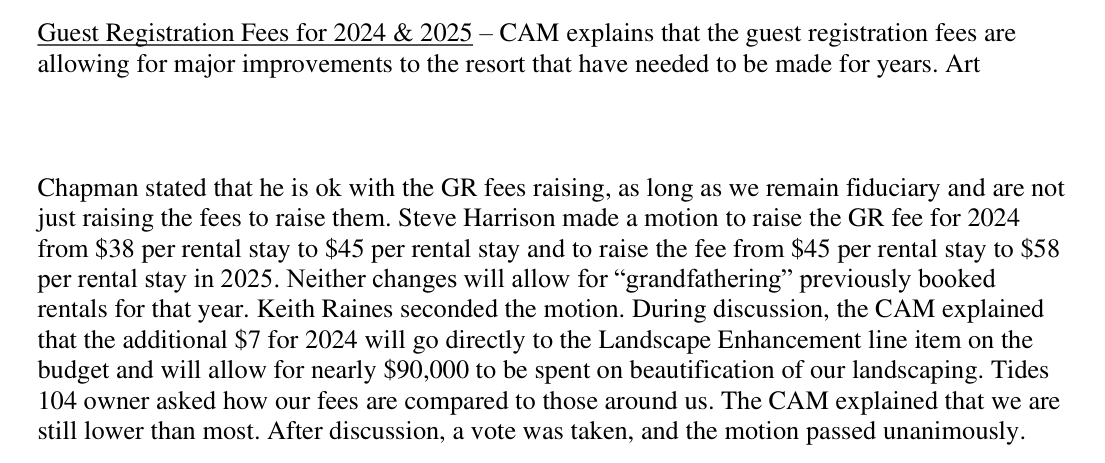
October 26, 2023, the reason is improvements: one motion raised the fee twice, to $45 and then $58, no grandfathering, with the $7 increase earmarked for landscaping, a benefit to the whole resort rather than a cost caused by guests. The cautions are minuted too. Chapman: fine, "as long as we remain fiduciary and are not just raising the fees to raise them." An owner asked how the fees compare to the neighbors; the manager: "we are still lower than most."
April 10, 2025, a reason is requested: discussing the next raise, Chapman "asked for a projection of costs as he wants to ensure we can justify what the new fee would be raised to." The board ordered it ready for August.

August 21, 2025, the reason is revenue: the minutes record the fee's revenue numbers being discussed, and the rationale in the board's own words: with big projects coming, "either assessments would get raised or another source of revenue is needed." $58 to $73, unanimous. The cost projection ordered in April appears nowhere in them. This is the only price in the fee's life whose stated reason is not a cost of hosting guests but the need for money itself.

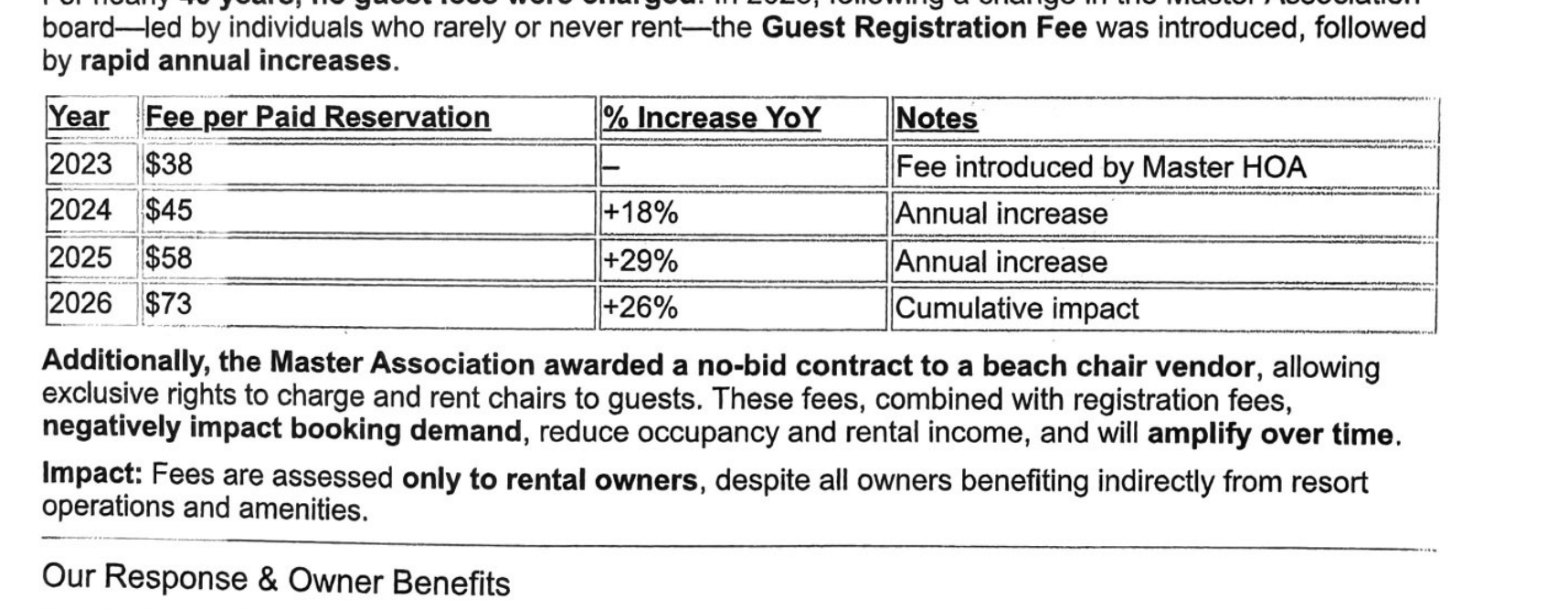
Four prices, four stated reasons, each in its exhibit: a check-in service, security equipment, landscaping, and finally revenue itself.
The wall it holds up
Somewhere along the way, the fee stopped being a fee.
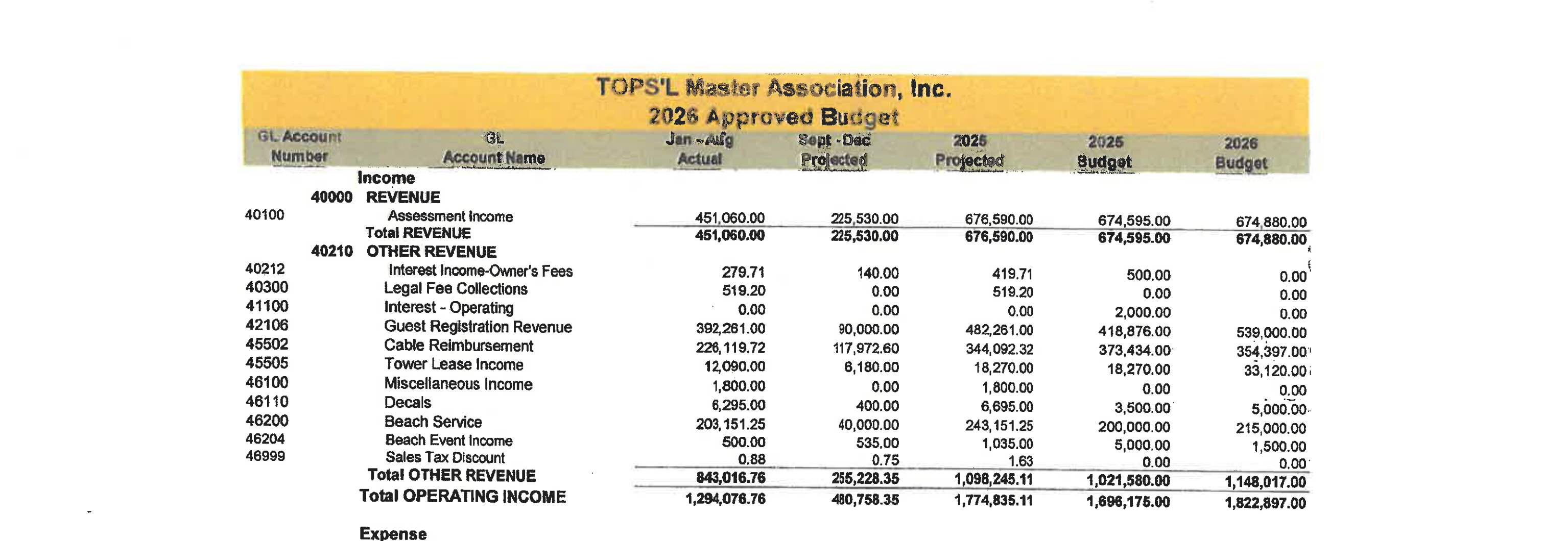
The approved 2026 budget books $539,000 in guest registration revenue beside $674,880 in owner assessments. For every dollar owners pay in dues, renters' guests put in about eighty cents. That is why quarterly dues have sat frozen at $285. Remove the fee and the arithmetic is unforgiving: replacing $539,000 from assessments alone is an increase of roughly 80% on every owner, renting or not.
What the fee actually pays for
Count IV's central factual claim is that the fee is untethered from "any specific costs." So what do the association's contracts, budgets, and minutes document as the costs of hosting guests?
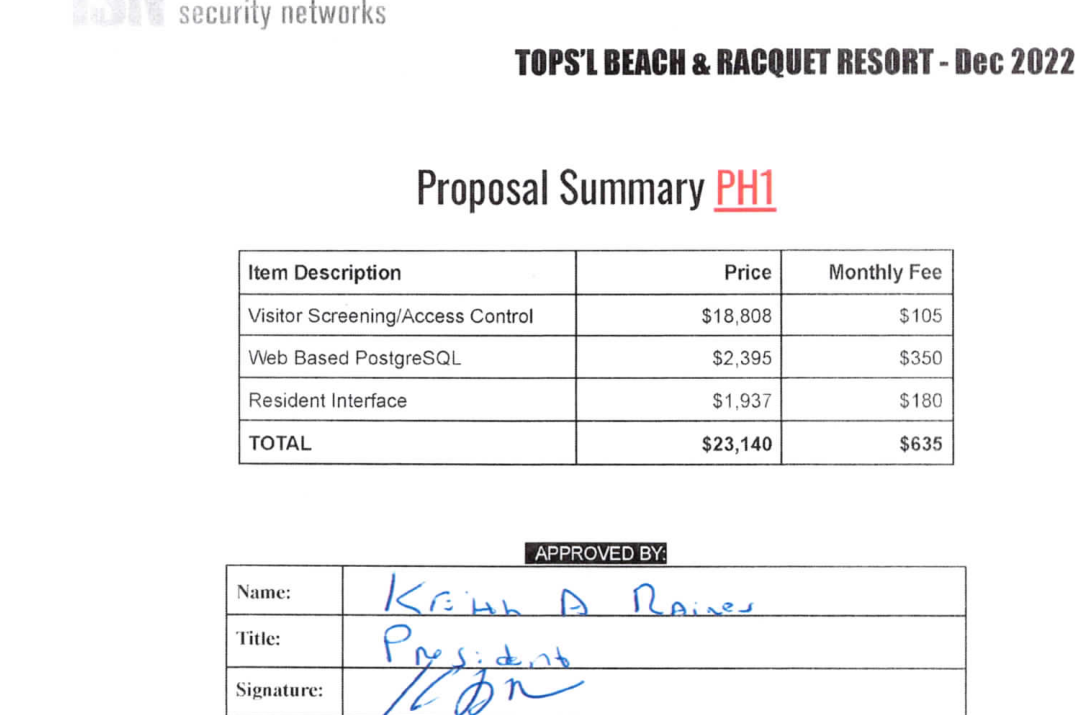
Start with what has receipts. The registration machinery itself was bought by contract in December 2022: the ISN visitor screening system, $23,140 to install plus $635 a month to run, approved over the signature "Keith A Raines, President."
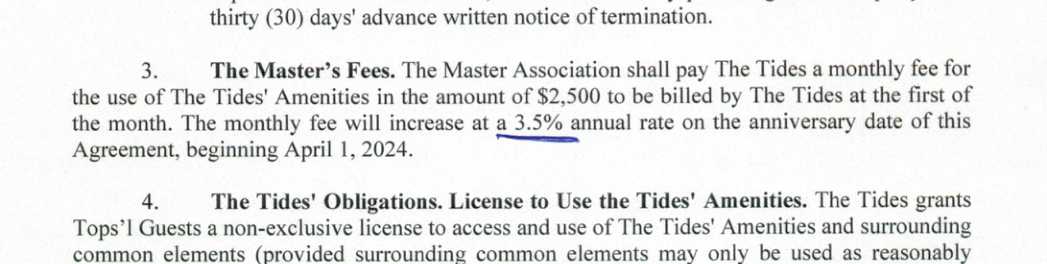
One guest amenity is bought by contract too. Since April 2023 the association has paid The Tides $2,500 a month, $30,000 a year rising 3.5% annually, so that "Tops'l Guests" can use the Tides' putt-putt course, shuffleboard, and basketball court.
And the largest candidate cost is a single budget line: Security Services, $580,000 for 2026. Registration and security share a gate, a staff, and a purpose. But what share of that $580,000 exists because of guests, no document anywhere says. There is no allocation, no study, and the cost projection a director requested in April 2025 does not appear in the August minutes that set the fee at $73.

What the gate is for
Half a million dollars of security. The minutes and contracts show what the gate's people do, and who the mission hired.
What are the gate's people for? The board answered when it set the fee's price in November 2022: keep traffic flowing while security staff "interface with the guest and confirm their reservation in the ISN system," a load heavy enough that a second entry lane was researched and engineering drawings procured. And the association's guest-registration briefing offers owners a round-the-clock service: call any hour "and Security will gladly enter your guest for you."

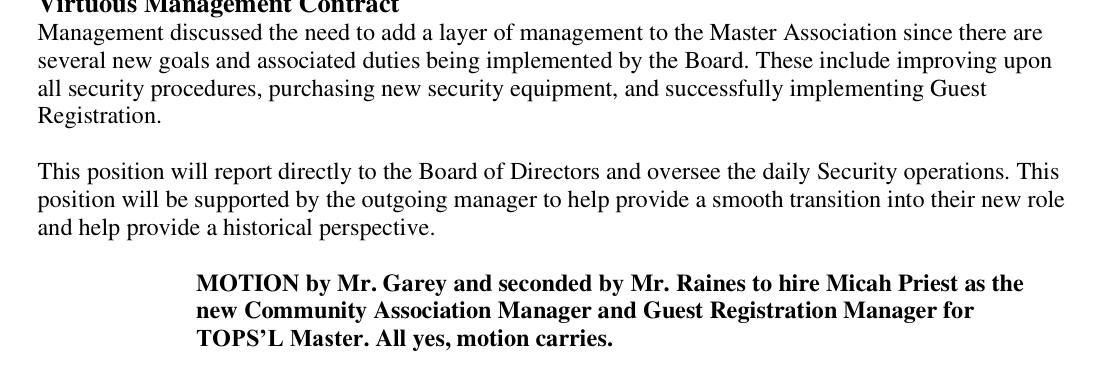
Second: the mission hired. "Hire additional Security Guards for the Department" appears in the Master's September 2021 goals, and by March 2023 the program had a management layer of its own, with a title that says everything:
And the cost arc is in the books. The 2023 budget package shows security payroll across the years the registration program arrived, next to a line that is guest-season by definition: off-duty sheriff's deputies for spring break.

How much of that growth is the registration mission and how much is wages and contracting is exactly what a cost study would answer. None appears in the minutes, and the projection requested in April 2025 does not appear in the August minutes that set the price. Whether $539,000 a year matches the costs is the question Ms. Frost raised in 2022, Mr. Chapman raised in 2025, and Count IV of the draft complaint now raises. You are holding the same documents every one of them had.
The neighbors
Every resort on this stretch of Highway 98 charges its guests. The comparison, with its sources.
| Property | Their guest fee | A 5-night stay |
|---|---|---|
| Palms of Destin | $25 per night ($5 per night long-term) | $125 |
| Seascape Resort | $28 per night peak, $14 off-season | $140 peak |
| Sandestin | ~$45 per day, as stated in the Summit's own minutes | ~$225 |
| TOPS'L today | $73 flat per reservation | $73 |
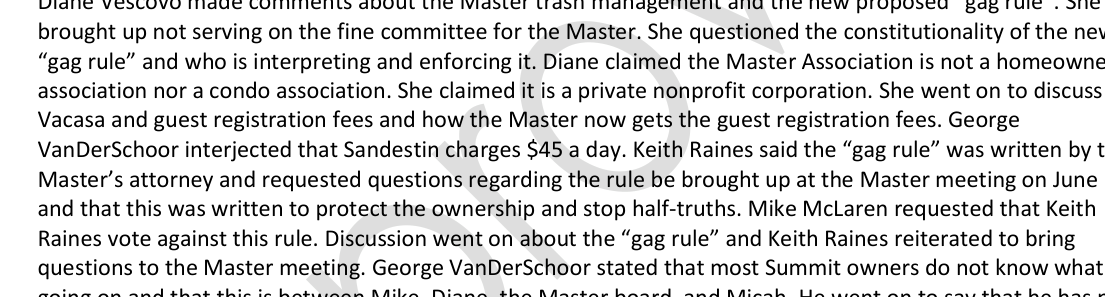
Three fairness notes the comparison requires. First, read the totals for the typical stay: at five nights, TOPS'L's $73 is the lowest figure on the list. Second, neighbors price per night, so a two-night TOPS'L guest pays far more per night than anywhere on this list while a monthly winter guest pays far less; the flat design, not the total, is what makes TOPS'L the outlier. Third, the neighbors' fees generally include amenity access, while what the TOPS'L fee buys is currently the subject of the dispute itself.
If the demand succeeds, who gets the refund?
Count IV would end the fee and unwind it backwards. The complaint's own text answers where the money would go.
The draft complaint mailed to every owner asks the court to declare the 2021 amendment invalid, enjoin collection of the fee, and, "to the extent permissible," order disgorgement of everything collected since 2023. The documented years alone put that clawback above $1.2 million, per the audits and year-end financial statements. Per the Walton County docket, this amended complaint has not been filed; the parties are in mediation, with a session set for September 22. Update, Sept. 26: the session ended without a settlement, and the amended complaint was still not on the docket at the September 23 check.
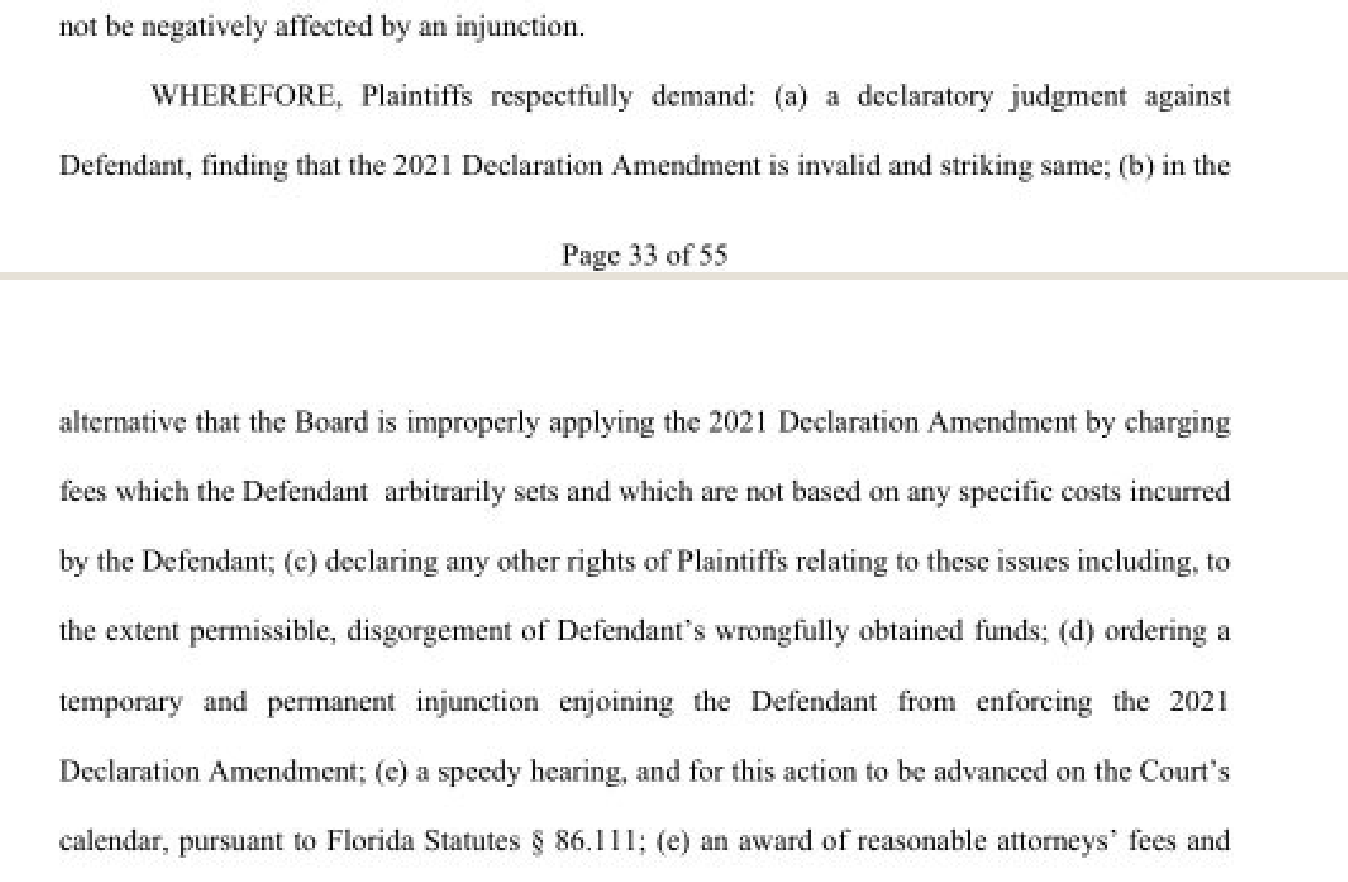
The complaint even carries a smaller case inside the big one: its clause (b), "in the alternative," challenges not the fee's existence but the increments the board set without a cost study.
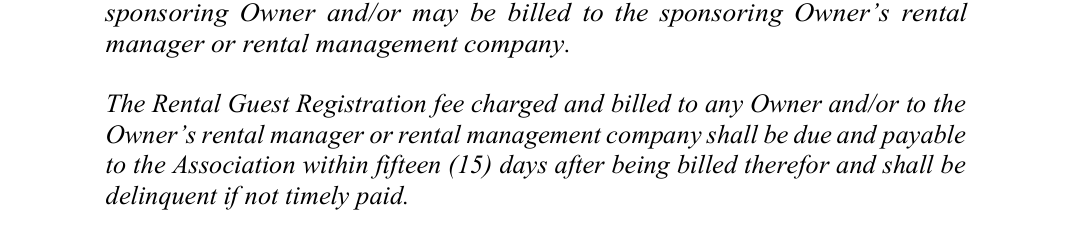
Say you rent your own unit yourself. No management company, so the fee is billed to you, by name, every reservation. Now suppose Count IV succeeds in full. Here is your ledger, illustrated at 15 bookings a year and the fee's actual rate each year:
| What happens | Your money |
|---|---|
| You already paid the fee. Every reservation since January 2023, as the rate climbed: $38, then $45, then $58, then $73. | −$3,210 |
| You pay the assessment that funds the refund. Documented collections top $1.2 million; spread across 592 units, about $2,000 each if the full demand is ordered. | −$2,030 |
| Your dues rise to replace the fee, for good. The $539,000 line refilled from assessments: dues from $285 a quarter toward roughly $513. | −$910every year |
| Your share of the refund. You are not a plaintiff. The complaint requests relief for SSP TOPS'L Properties and TOPS'L Club of NW Florida. To recover your own fees you would have to bring your own claim, against the association you fund. | $0 |
| The owner who paid the fee | about $5,200 out, then $910 a yearrefunded: nothing |
And if you never rent, skip the first line: you paid no fee, yet lines two and three are still yours.
Every line is drawn from the complaint's text and the association's budget, both shown on this page. The dollar figures illustrate one owner at 15 bookings a year, priced at the fee's real rate for each year ($38 in 2023 through $73 in 2026); a court could order less than the full demand.
A problem owners can fix
That a fee is justified is not really the question. The costs are in the contracts above: the registration system, the Tides amenities, the guards at the gate. What is missing is the one thing every objection asked for, a study that sizes the fee to those costs in the open, so any owner can see the number is fair. That is a matter of transparency, and four years on it is still unanswered.
Which is what makes the demand so strange. A for-profit company is asking a court to order a "refund" of the fee. But read the ledger again: not a dollar of it goes back to the owners who paid. The money flows to the company that brought the claim, while owners are assessed to fund it. A payment that returns nothing to the people who paid is not a refund. It is a transfer, from the owners to the plaintiffs, SSP TOPS'L Properties and TOPS'L Club of NW Florida.
One email when a new chapter or update is published. No ads, and your address is used for nothing else. Every email has a one-click unsubscribe.
You will get a confirmation email first. Nothing is sent until you click the link in it.
Corrections, leads, documents, recordings, evidence: send them. It does not matter which side of this you are on. But know how it works here: a claim is a start, and a claim with a document behind it is a fact this site can publish. Without evidence, it is just another post.
Better still, do what we do. Save the email. Keep the letter. Screenshot the post before it disappears. Write down the date.
The goal is simple: that every owner, including the one writing this, knows exactly what is happening here. Everything sent gets read and checked against the record. Confidentiality respected on request.